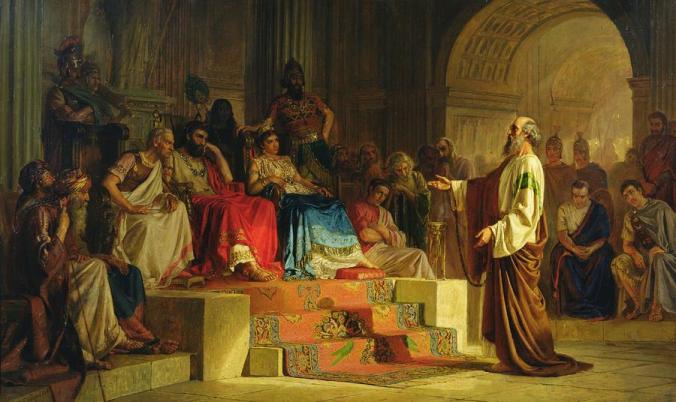
The Death Of Paul And Peter

According to Church history, all apostles but John, the disciple whom Jesus loved, were martyred. In The First Epistle of Clement to the Corinthians, a letter sent from the church of Rome to the church of Corinth, written probably in time of Domitian, c. 96 A.D, we find the record of the death of Peter and Paul.
Drawing examples from Cain,Esau, Josephs’ brothers, Marian and Aaron, and Soul’ jealousy from Old Testament, the author of this epistle, showed how that sin rose up to the persecution of ones own the brothers. The author of this epistle went drew New Testament examples, giving an early record of the death of Peter and Paul:
BUT, to cease from the examples of old time, let us come to those who contended in the days nearest to us; let us take the noble examples of our own generation. Through jealousy and envy the greatest and most righteous pillars of the Church were persecuted and contended unto death. Let us set before our eyes the good apostles: Peter, who because of unrighteous jealousy suffered not one or two but many trials, and having thus given his testimony went to the glorious place which was his due. Through jealousy and strife Paul showed the way to the prize of endurance; seven times he was in bonds, he was exiled, he was stoned, he was a herald both in the East and in the West, he gained the noble fame of his faith, he taught righteousness to all the world, and when he had reached the limits of the West he gave his testimony before the rulers, and thus passed from the world and was taken up into the Holy Place,—the greatest example of endurance.(Clement I, 5:1-7, Lake)
Their death is also echoed in the Pseudo-Ignatius* lettes. In the The Epistle of Ignatius to Mary, we find that the author, probably not Ignatius of Antioch, affirmed the news from Rome; “Now it occurs to me to mention, that the report is true which I heard of thee whilst thou wast at Rome with the blessed father Linus, whom the deservedly-blessed Clement, a hearer of Peter and Paul”( Chapter 4, Ignatius, ed. Roberts, Donaldson and Coxe, p. 122), and in The Epistle of Ignatius to the Tarsians, also a Pseudo-Ignatius epistle, chapter 3, we also find the death of Peter, Paul and other disciples:
Mindful of him, do ye by all means know that Jesus the Lord was truly born of Mary, being made of a woman; and was as truly crucified. For, says he, “God forbid that I should glory, save in the cross of the Lord Jesus.” And He really suffered, and died, and rose again. For says [Paul], “If Christ should become passible, and should be the first to rise again from the dead.” And again, “In that He died, He died unto sin once: but in that He liveth, He liveth unto God.” Otherwise, what advantage would there be in [becoming subject to] bonds, if Christ has not died? what advantage in patience? what advantage in [enduring] stripes? And why such facts as the following: Peter was crucified; Paul and James were slain with the sword; John was banished to Patmos; Stephen was stoned to death by the Jews who killed the Lord? But, [in truth,] none of these sufferings were in vain; for the Lord was really crucified by the ungodly. (ibid, p. 107)
Source:
Clement I, P., Clement I, P., Ignatius, S., Bishop of Antioch, Polycarp, S., Bishop of Smyrna, & Lake, K. (1912-13). The Apostolic fathers (P. Clement I, S. Ignatius, Bishop of Antioch, S. Polycarp, Bishop of Smyrna & K. Lake, Ed.). The Loeb classical library. London; New York: Heinemann; Macmillan.
The Ante-Nicene Fathers, Volume I: The Apostolic Fathers with Justin Martyr and Irenaeus. 1885 (A. Roberts, J. Donaldson & A. C. Coxe, Ed.) . Buffalo, NY: Christian Literature Company.affirms
* These letter are called Pseudo-Ignatius‘ epistles because they are probably not written by Ignatius of Antioch . Their vocabulary and style is not the same as the widely accepted Ignatius’ letters ( To the Ephesians, To the Magnesians, Letter to the Trallians, To the Romans, To the Philadephians, To the Smyrnaeans and To Polycarp)
Fight For Us, O God

“Fight for us, O God, that we not drift numb and blind and foolish into vain and empty excitements. Life is too short, too precious, too painful to waste on worldly bubbles that burst. Heaven is too great, hell is too horrible, eternity is too long that we should putter around on the porch of eternity.”
Early Church’s Understanding Of Isaiah 9:6

In Against Heresies Book II chapter 19, Irenaeus( c. 120- 28th of June 202 A.D), a bishop of Lyons, taught by a claimed disciple of apostle John, Polycarp ( c.69 – 155 A.D) the bishop of Smyrna, we find early church’s understanding of Isaiah 9:6, to which I wish to share:
For this reason [it is said], “Who shall declare His generation?” since “He is a man, and who shall recognise Him?” But he to whom the Father which is in heaven has revealed Him, knows Him, so that he understands that He who “was not born either by the will of the flesh, or by the will of man,” is the Son of man, this is Christ, the Son of the living God.
For I have shown from the Scriptures, that no one of the sons of Adam is as to everything, and absolutely, called God, or named Lord. But that He is Himself in His own right, beyond all men who ever lived, God, and Lord, and King Eternal, and the Incarnate Word, proclaimed by all the prophets, the apostles, and by the Spirit Himself, may be seen by all who have attained to even a small portion of the truth.
Now, the Scriptures would not have testified these things of Him, if, like others, He had been a mere man. But that He had, beyond all others, in Himself that pre-eminent birth which is from the Most High Father, and also experienced that pre-eminent generation which is from the Virgin, the divine Scriptures do in both respects testify of Him: also, that He was a man without comeliness, and liable to suffering; that He sat upon the foal of an ass; that He received for drink, vinegar and gall; that He was despised among the people, and humbled Himself even to death; and that He is the holy Lord, the Wonderful, the Counsellor, the Beautiful in appearance, and the Mighty God, coming on the clouds as the Judge of all men;—all these things did the Scriptures prophesy of Him.
Source:
The Ante-Nicene Fathers, Volume I: The Apostolic Fathers with Justin Martyr and Irenaeus. 1885 (A. Roberts, J. Donaldson & A. C. Coxe, Ed.) (449). Buffalo, NY: Christian Literature Company. (paragraphs added)
Modern Myth: All but 11 verses of the NT could be constructed from the writings of the early church fathers
Reblogged from Theo-sophical Ruminations:

Have you ever heard it said—or said it yourself—that if all the Bibles and Biblical manuscripts in the world were destroyed tomorrow, we could reconstruct all but 11 verses of the NT from the writings of the Ante-Nicene Church Fathers alone? Recently, while listening to an interview featuring NT textual critic, Daniel Wallace, I learned that this claim is demonstrably false.[1] Unfortunately this has been repeated in one form or another by many individuals, including prominent NT textual critics. …
Early Church’s Understanding Of the Holy Spirit

In the past two months, I have being digging into the early Church fathers’ writings before the Council of Nicaea(325 A.D.), with an aim of understanding the early Church’s views of the person and work of Christ Jesus, the Holy Spirit and the relationship between the Father, Son and Holy Spirit.
In this article I shared with my blog readers a writing on role of the Holy Spirit, found in chapter 25 of the Fragments from the Lost Writings of Irenaeus( c. 120- 28th of June 202 A.D), a bishop of Lyons, taught by the bishop of Smyrna Polycarp ( c.69 – 155 A.D) also claimed disciple of apostle John, and the person of the Holy Spirit found in Titus Flavius Clemens (c.150 – c. 215) of Alexandria’s exposition of Luke 3:22.
Irenaeus on the work of the Holy Spirit:
Know thou that every man is either empty or full. For if he has not the Holy Spirit, he has no knowledge of the Creator; he has not received Jesus Christ the Life; he knows not the Father who is in heaven; if he does not live after the dictates of reason, after the heavenly law, he is not a sober-minded person, nor does he act uprightly: such an one is empty. If, on the other hand, he receives God, who says, “I will dwell with them, and walk in them, and I will be their God,” such an one is not empty, but full.
Clement of Alexandria on Luke 3:22:
God here assumed the “likeness” not of a man, but “of a dove,” because He wished, by a new apparition of the Spirit in the likeness of a dove, to declare His simplicity and majesty.(From The Catena On Luke, edited by Corderius)
Source:
The Ante-Nicene Fathers, Volume I: The Apostolic Fathers with Justin Martyr and Irenaeus. 1885 (A. Roberts, J. Donaldson & A. C. Coxe, Ed.). Buffalo, NY: Christian Literature Company.( Ireneaus Quote from Chapter XXVI p. 572 )
The Ante-Nicene Fathers, Volume II: Fathers of the Second Century: Hermas, Tatian, Athenagoras, Theophilus, and Clement of Alexandria (Entire). 1885 (A. Roberts, J. Donaldson & A. C. Coxe, Ed.) (578). Buffalo, NY: Christian Literature Company.